|
ABOUT THE BOOK -
EXCERPT FROM THE PARENTING GUIDANCE SECTION
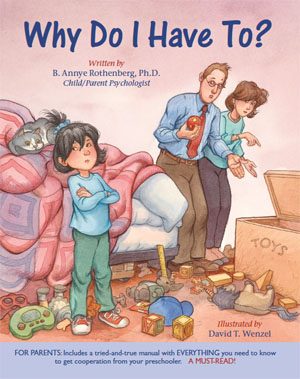
Why Do I Have To?
 Establishing
Family Values Establishing
Family Values
All families have to develop limits and
rules that cover safety, respect, and routines and habits. It can be
hard for parents to know which rules are age-appropriate, and in accord
with their own family values, and within accepted community and
cultural norms. The wide range of other families’ rules and limits
often adds to parents’ uncertainty. To develop reasonable and
achievable rules and limits, it helps to discuss with your spouse what
values you both want to teach your child. These important conversations
can be enjoyable, thoughtful, and insightful. Discussions of family
values are generally low-conflict and tend to build the parenting
partnership. Share what characteristics you’d like to see in your child
by kindergarten, as a teen, even as an adult. Are you and your spouse
modeling these traits? If not, are you willing to work on them? Talk
about your goals for yourselves and your children in such areas as
relating to others, making decisions, dealing with conflict, handling
difficult emotions, working hard to succeed at a task, taking care of
your bodies, handling money, using time, and caring for possessions.
RULES PRESCHOOLERS SHOULD
LEARN
Parents need to learn reasonable expectations for their child at each
age. You can do this by reading about child development; talking to
teachers or your pediatrician; chatting with parents casually or at
parenting classes; observing other children at the playground, on play
dates, and at preschool; and taking care of other children. Knowing
what to expect makes it easier to determine appropriate rules for your
child’s age. It’s valuable to use phrases with your young child such as
“It’s Mommy’s and Daddy’s job to teach you everything that a ____
-year-old needs to know.” This concept helps reinforce that rule-making
is a parent’s job. Children should also be given reasons for new or
changed rules: “We need to get dressed quickly today because…” And it’s
important to praise children for cooperating: “You picked up your toys
so fast – that was great,” or “That was so helpful.” Parents need to
determine effective methods for getting cooperation, such as making
requests sound like fun. And the child needs to understand the
consequences of not cooperating. Both will be addressed in detail later
in this guide book.
|
